
Reviewed by Clarrie King, licensed stonemason · Premier Stone, Drouin VIC · Updated June 2026

Porcelain kitchen benchtops, also called sintered stone, are a non-porous, heat and scratch resistant surface that never needs sealing. Fired from natural minerals with no resin, they sit outside Australia’s engineered stone ban, come in large-format slabs and consistent marble, stone and concrete looks, and typically cost around $400 to $1,050 per square metre supplied and installed.
Porcelain has become one of the most popular benchtop surfaces in Melbourne since the engineered stone ban, and for good reason: it delivers the low-maintenance performance renovators want without the resin that got quartz banned. Here’s the full picture: pros, cons, colours, thickness and cost.
Considering porcelain for a Melbourne kitchen? Premier Stone supplies and fabricates large-format porcelain from our Drouin workshop. See our benchtop services → or call 1300 282 065.
Porcelain benchtop prices in Melbourne
| What you are pricing | Typical Melbourne cost |
|---|---|
| Supplied and installed | about $400 to $1,050 per m² |
| Slab only | about $350 to $550 per m² |
| Standard galley or L-shaped kitchen | about $5,000 to $6,500 installed |
| Premium brands or complex fabrication | about $700 to $2,000 per m² |
Indicative market ranges. Your price depends on the brand, thickness, edges, cut-outs and access. See the full porcelain benchtop cost breakdown.
Get a free porcelain quote or call 1300 282 065. We supply, cut and install porcelain across Melbourne.
What is a porcelain benchtop?
A porcelain benchtop is a large-format surface fired from natural clays and minerals at extreme temperatures, with no resin binder. That firing makes it dense, non-porous and extremely hard. In the benchtop world “porcelain” and “sintered stone” describe essentially the same product. Because there is no resin, porcelain is excluded from Australia’s engineered stone ban while still offering the low-maintenance feel people loved about quartz.
Porcelain benchtop pros and cons
Porcelain leads on maintenance and heat, with one caveat around edges. Weigh it against how you use your kitchen.
| Pros | Cons |
|---|---|
| Non-porous . Never needs sealing | Edges can chip if struck hard |
| Excellent heat resistance . Hot pots ok | Requires skilled fabrication |
| Scratch & stain resistant; hygienic | Pattern is surface-printed (not full-body in all ranges) |
| UV-stable . Suits outdoor kitchens | Premium price vs laminate |
| Large-format slabs for join-free islands | Fewer “natural” one-off looks than stone |
How much do porcelain benchtops cost?
As a general market guide, porcelain kitchen benchtops in Melbourne run about $400 to $1,050 per square metre supplied and installed, depending on brand, slab, thickness and edge. A 12mm porcelain top is slimmer and lighter and suits a sleek modern look; a 20mm top or a 40mm mitred edge gives a more substantial profile. For an exact figure see our stone benchtop cost guide or request a measured quote.
What thickness and colours are available?
Porcelain comes in 12mm, 20mm and built-up 40mm edges. Thinner 12mm suits minimalist designs and splashbacks; 20mm and 40mm read as a classic stone benchtop. Colours are wide and consistent, covering white and grey marble looks, solid black and white, concrete and natural-stone looks. Because the pattern is printed and fired, slabs are highly repeatable, which is ideal for large islands and book-matched feature panels.
Comparing options? See the best stone benchtops and the full materials comparison.
Is porcelain right for your kitchen?
Choose porcelain if you want a fit-and-forget surface: busy family kitchens, households that cook with heat, and outdoor or alfresco kitchens where UV stability matters. If you specifically want the one-off character of natural geology, granite or quartzite may suit you better. For most modern Melbourne kitchens, porcelain is the lowest-maintenance way to get a premium stone look.
What are the disadvantages of porcelain benchtops?
Porcelain has three real drawbacks. It is brittle at the edges, so it can chip on hard impact and needs careful handling during fabrication and install. Fabrication costs more, because the material demands diamond tooling and slower cutting. And repairs are difficult: a chip in porcelain cannot be filled and polished out the way a scratch in granite can. Colour is printed on the surface on cheaper single-loaded slabs, so a deep chip can show a paler body underneath. Full-body slabs avoid that and cost more.
Porcelain vs Caesarstone: which should you choose?
Both are current, legal options in Australia, and the choice comes down to maintenance and look. Caesarstone did not disappear with the 2024 engineered stone ban. The banned product was quartz-resin engineered stone, not the brand, and Caesarstone now sells silica-free Mineral and porcelain ranges. Porcelain is non-porous, never needs sealing, and handles heat and UV better, which makes it the stronger pick for indoor-outdoor kitchens and heavy-use family kitchens. Caesarstone’s current ranges offer a wider set of consistent colours. On price, published Australian figures put Caesarstone from around $500 to $800 per square metre and porcelain around $400 to $1,050 supplied and installed, so they overlap.
Which porcelain and sintered brands does Premier Stone supply?
Premier Stone supplies, fabricates and installs Dekton by Cosentino, Neolith, Laminam and Asetica, plus Caesarstone’s porcelain range. All are sintered or porcelain surfaces with no resin binder, so they sit outside the engineered stone ban. Dekton carries an A1 non-combustible fire classification, which is why the same material is used for fireplace hearths as well as benchtops.
Large format porcelain slabs and panels
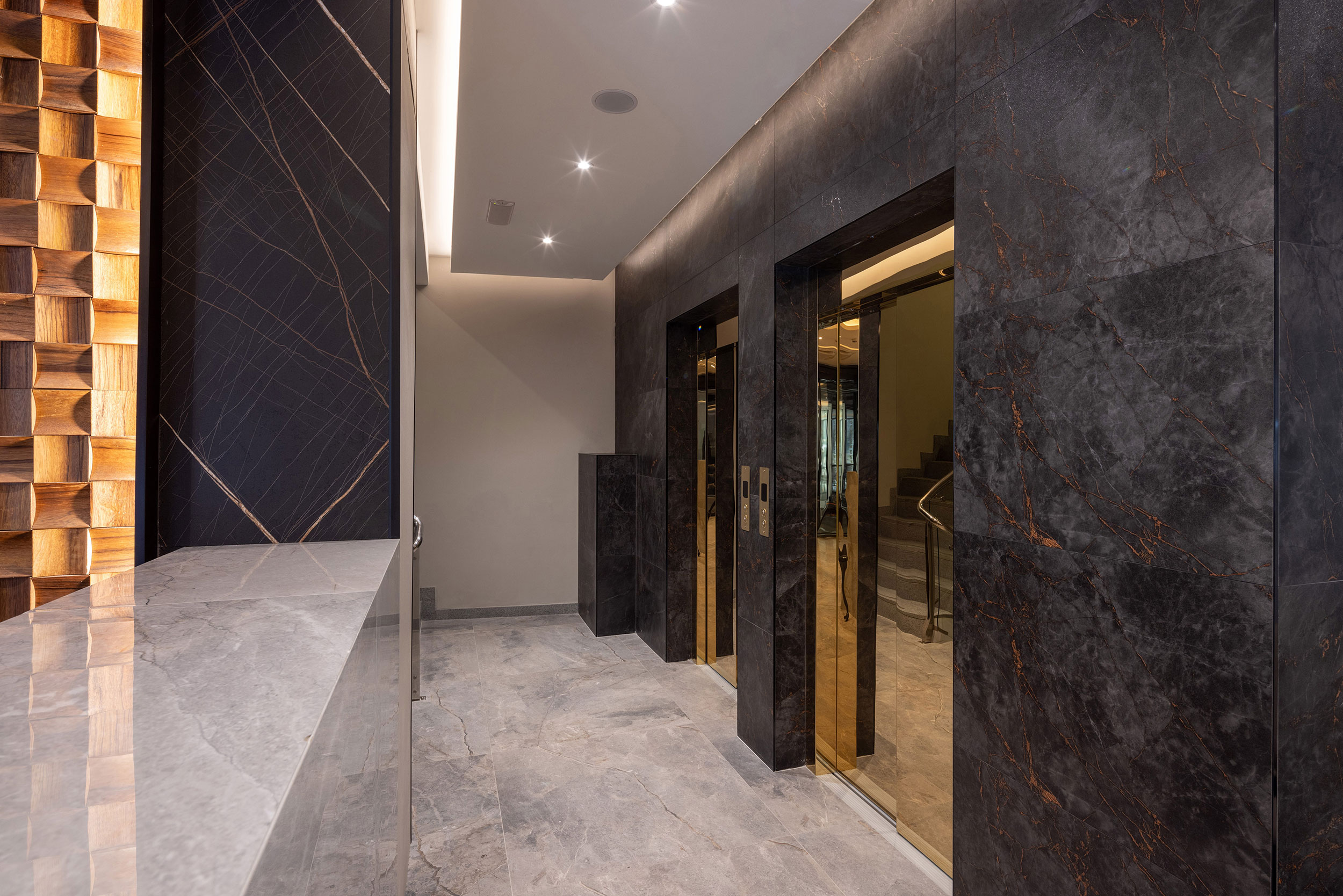
Large format porcelain is where the material pulls ahead of natural stone. Slabs run up to about 3200mm x 1600mm, which is larger than most granite or marble blocks yield, so a long run or an island can often be cut with no join at all. The same slab can carry through to a full-height splashback or a waterfall end for a single continuous grain. Large format also suits commercial fit-outs, reception counters and bar tops, where join lines are the first thing that dates an installation.
Frequently Asked Questions
Are porcelain benchtops good for kitchens?
Yes. Porcelain benchtops are non-porous, scratch and stain resistant, never need sealing, and tolerate heat from pots straight off the cooktop. They are UV-stable for outdoor kitchens and come in large-format slabs. The main caution is that edges can chip if struck hard, so professional fabrication matters.
How much do porcelain kitchen benchtops cost?
As a general market guide, porcelain kitchen benchtops in Melbourne cost roughly $400 to $1,050 per square metre supplied and installed, depending on brand, slab, thickness and edge. A measured quote is the only accurate figure.
Is porcelain the same as sintered stone?
In benchtops the terms are used interchangeably. Both describe a large-format surface fired from natural minerals at extreme heat with no resin binder, which is why they sit outside the engineered stone ban. They are non-porous, heat and scratch resistant.
Do porcelain benchtops chip or scratch?
Porcelain is very scratch resistant on its surface, but like any hard, thin fired material it can chip on an exposed edge if hit hard. Good fabrication, a sensible edge profile and normal care prevent this.
What colours do porcelain benchtops come in?
Porcelain comes in white and grey marble looks, solid blacks and whites, concrete and stone looks, and warm neutrals. Because the pattern is printed and fired, slabs are highly consistent, which suits large islands and book-matched panels.
Want the full cost breakdown? See how much porcelain benchtops cost in Melbourne, with published market ranges by slab, thickness, edge and kitchen size.
More guides from Premier Stone:
- Kitchen Benchtop Materials Compared: A Melbourne Buyer’s Guide
- The Best Stone Benchtops for Australian Kitchens
- How Much Do Stone Benchtops Cost in Melbourne?
- Dekton Benchtops: Cost, Pros and Cons
Ready to choose porcelain?
Get a Measure & Quote · Our Services · See Projects · Call 1300 282 065